

Chords, Keys, Scales, Modes and Paramore, Pg3
Here's the third and final page of my e-mail conversation with Dave. For the first part, go here. Again, Dave's text is in yellow and my text is in white.
DAVE: I now have had a chance to digest your latest e-mail, which is very well written. 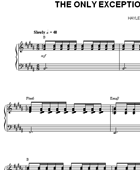
(click image to enlarge)I understand what you're thinking although I would like to let it percolate a bit before I fully buy in. I've also dialed in two acoustic cuts of the song on YouTube and you can get a much better idea of what the basic guitar structure is by watching/listening to the videos.
[view video below]
Also I decided to see if I could find how "sheet music" organizations were notating the song. The first one I came across was Music Notes. Interestingly enough they notate it as being in the key of B
[click image to view].
Sheet Music Plus also notates it the same. I couldn't find any music that notated it in E.
Thanks for your thoughts on all this. I enjoyed the dialog.
ME: Thanks for your comments. I love the fact that you digested what I said and then checked it against other sources!
I listened to the live versions you provided, and like you said, the chords are easier to hear than in the studio version. I think it's fairly clear that the 2nd chord is an F#m and not an F# major. What do you think? If you agree with the F#m, which I think you said you did, then the question is- what keys use an F#m?
I looked at the MusicNotes link you provided. You're absolutely correct that the key signature provided is indeed B. Did you notice in the music, however, that they notated an F#m in the 2nd measure and that the music has an accidental (an added sharp, flat, or natural not found in the key signature) of an A natural in that measure instead of the A# in the key signature? So, that accidental indicates the chord is "out of key." An additional sharp or flat to a chord or melody means that the note is somehow coming from a key other than the indicated key- even if it's a temporary change of keys (like just for a single measure). If they had made the key in E, then there would be no need for any accidentals anywhere on the page. If the song also included an F# major chord somewhere in the verse or chorus, then the argument that the F#m chord is a temporary borrowed chord is plausible. If you looked at the music, and they always used a natural sign on the A, and never an A#, then I'd suggest that it's better to think of the song as a mode of E. The main thing is that if you played the notes that MusicNotes provides, it'll still SOUND correct- even if I think their use of music theory is not as completely accurate as it could be. If you're really curious, I'd try to find a theory professor, website, or a jazz player with a firm grasp of theory and ask them what they think. The main things to look at are B major vs E major vs B Mixolydian.
Music theory is an interesting discipline. The deeper you go, the more you'll find that people disagree on certain aspects of it. Sometimes two ways of thinking can both explain the same thing, and the difference on which you prefer could come down to preference.
As far as published music goes - I've found mistakes in even some of the best transcriptions. I have a guitar method book from Mel Bay, a very well known publisher, that has a song written with a 4/4 time signature, but where every measure is clearly in 3/4. A simple, but very noticeable mistake. Usually competent publishers don't make such glaring mistakes, but it does sometimes happen.
Even if you never quite agree with what I'm arguing for, I hope that our exchange has given you a deeper understanding of the kinds of questions musicians have to make when trying to decide if they should indicate things in music one way or another.
Thanks for the interesting questions and best of luck!!

![[submit to delicious]](../images/other/deliciousIcon.jpg)
![[submit to digg]](../images/other/digg.gif)
![[submit to reddit]](../images/other/reddit.gif)